At a glance
Foreign customers keep using the apps they use at home when they come to Korea. So which platforms you need to manage depends on which customers you want to welcome.
Google Maps is the shared window that customers from many countries check, while customers from mainland China use Xiaohongshu, Dianping and Amap together. Whatever the mix, basic information such as your name, address and hours must be the same everywhere.
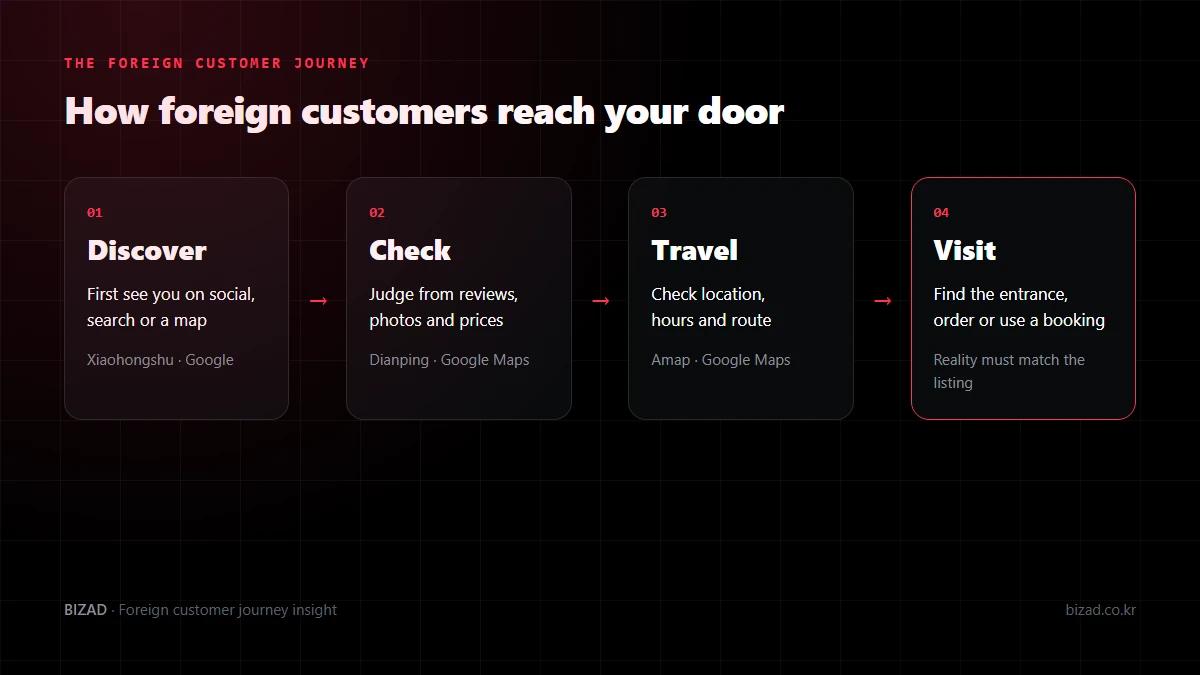
What steps do foreign customers go through before visiting?
Broadly, four steps: discover, check, travel and visit. They first see you on social media or in search, check you through reviews and photos, then find their way to you on a map.
- Discover: they first see you in social content, search results or a nearby search on a map.
- Check: they judge whether you are worth it from reviews, ratings, photos, menu and prices.
- Travel: they check your location, hours and route on a map.
- Visit: they find the entrance and order or use the service they booked.
Customers may use a different app at each step, and if the information breaks at one step they do not move on to the next. That is why it pays to look at the whole journey, not just one platform.
Why do foreign customers use apps other than Naver to find businesses?
Because they keep using the apps they use at home while travelling. Rather than installing and learning a new app for a trip, they usually search and navigate with the apps they know.
Many also research and save places they want to visit while planning, before they even arrive in Korea. The app they used before departure simply carries on during the trip.
Even if your Naver Place listing is well managed for Korean customers, foreign customers may not see you at all if their apps have no information about you. Naver and the platforms foreign customers use do not replace each other; they need to be managed side by side.
Do customers from different countries use different platforms?
Yes. Individuals vary even within one country, but the search, review and map apps people use differ by where they come from, so the route by which they find you differs too.
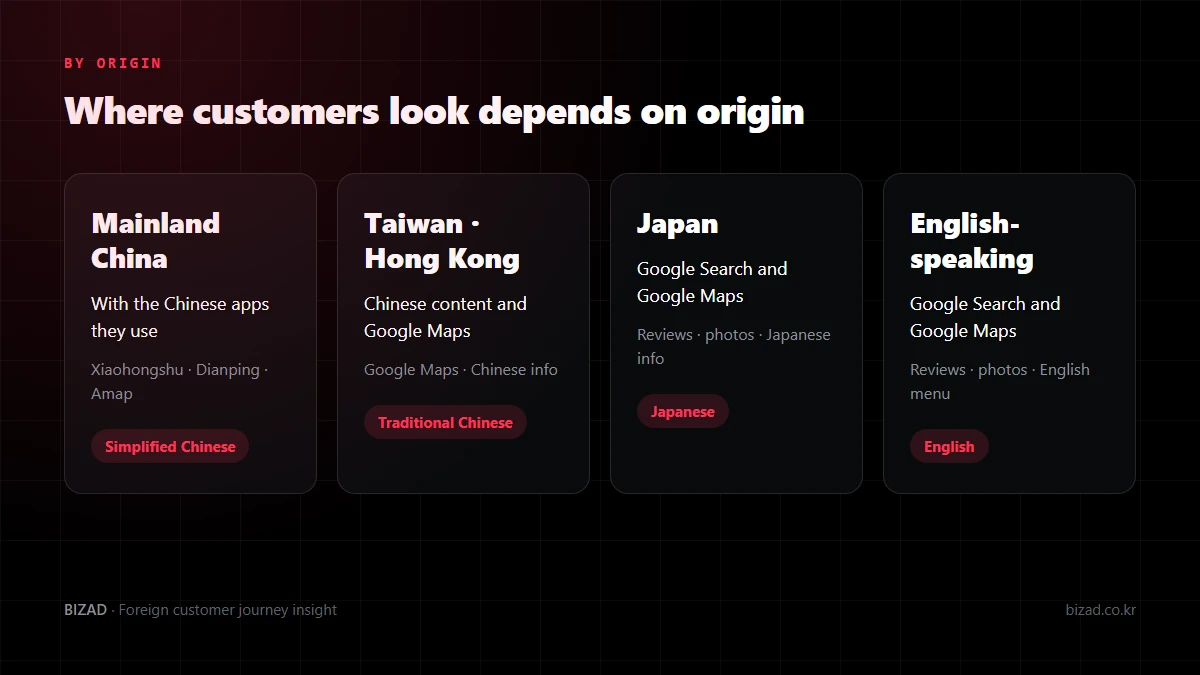
| Customers | Where they mainly check | What helps to prepare |
|---|---|---|
| Mainland China | Xiaohongshu, Dianping, Amap | Simplified Chinese name and information, consistent details across all three |
| Taiwan / Hong Kong | Google Maps, Chinese-language content | Information that reads well in Traditional Chinese, Google Maps details |
| Japan | Google Maps, Google Search | Japanese menu and information, review replies |
| English-speaking | Google Maps, Google Search | English menu and information, specific business details |
This table shows a general tendency and will not fit every customer. Asking your own customers where they are from and which app brought them will give you a more accurate picture.
Which platforms do customers from mainland China need?
It is best to prepare Xiaohongshu, Dianping and Amap together. Customers from mainland China often discover, check and find their way to a business with the apps they use every day in China.
- Xiaohongshu: before and during the trip, they discover places through content and save them.
- Dianping: they check whether a place is worth going to through ratings, reviews, photos and prices.
- Amap: they check the location, route and opening hours.
The three platforms play different roles, so managing only one easily breaks the journey halfway. Interest sparked on Xiaohongshu rarely becomes a visit if customers cannot confirm you on Dianping or find you on the map.
Should we prepare for Taiwanese and Hong Kong customers the same way as for mainland Chinese customers?
Not exactly. Customers from Taiwan and Hong Kong read Chinese yet also use Google Maps a lot, so it is best to look after both Chinese-language information and Google Maps.
Taiwan and Hong Kong mainly use Traditional Chinese characters, while mainland China uses Simplified characters. Even within Chinese, character forms and expressions can differ a little, so when making a menu or signage it helps to decide which customers it is for.
An accurate name, description and menu photos on Google Maps help not only customers from Greater China but visitors from other countries as well.
What matters to Japanese and English-speaking customers?
Both groups often check reviews, photos, location and opening hours on Google Search and Google Maps. So the basic information and review management on your Google Business Profile is the starting point.
The more specific a review is, the more it helps, more than the star rating alone. Reviews describing real experiences, such as “the menu had photos so ordering was easy” or “it was close to the station and easy to find”, help travellers in the same situation picture their visit.
- Japanese customers: a Japanese menu or information, and short replies to Japanese reviews
- English-speaking customers: an English menu and conditions such as whether solo or walk-in visits are fine
- Both: an entrance photo, payment methods, accurate opening hours and break time
If you say “English spoken” or “Japanese menu available”, you need to be able to deliver it. When the listing and reality differ, the gap shows up in reviews.
How should we combine platforms?
We recommend making Google Maps your base and adding platforms according to the customers you want. Google Maps is the shared window for customers from many countries, and Xiaohongshu, Dianping and Amap are added if you want customers from mainland China.
- All foreign customers: get Google Maps (your Google Business Profile) in order as the base.
- Mainland China: add Xiaohongshu for discovery, Dianping for checking and Amap for directions.
- Taiwan / Hong Kong: add information and photos on Google Maps that read easily in Chinese.
- Japan / English-speaking: look after foreign-language menus, photos and review replies on Google Maps.
You do not need to start every platform at once. Deciding first who comes now and who you want to welcome makes it easier to choose where to spend your time.
At BizAd, we look at Google Maps SEO, Xiaohongshu, Dianping and Amap together, according to how customers move.
Why must business information be identical across platforms?
Because customers move between several apps to find the same place again. If the name or address differs between apps, they cannot tell whether it is the same place or which information is correct.
| Information to align | What happens if it differs |
|---|---|
| Business name (including foreign-language spellings) | They cannot find the same place in another app |
| Address and map location | They go to the wrong place or wander nearby |
| Opening hours and closing days | They arrive to a closed door |
| Prices and promotions | The price feels different on site |
| Phone number and booking method | Enquiries never reach you |
When something changes, we recommend updating every platform customers see on the same day rather than just one. Keeping a list of places to update means nothing gets missed.
How is AI search changing the way foreign customers find businesses?
More people are searching with questions instead of keywords. Instead of “Gangnam restaurant”, they ask something like “recommend a Korean BBQ place in Gangnam that’s good for going with friends” and choose from the answer the AI puts together.
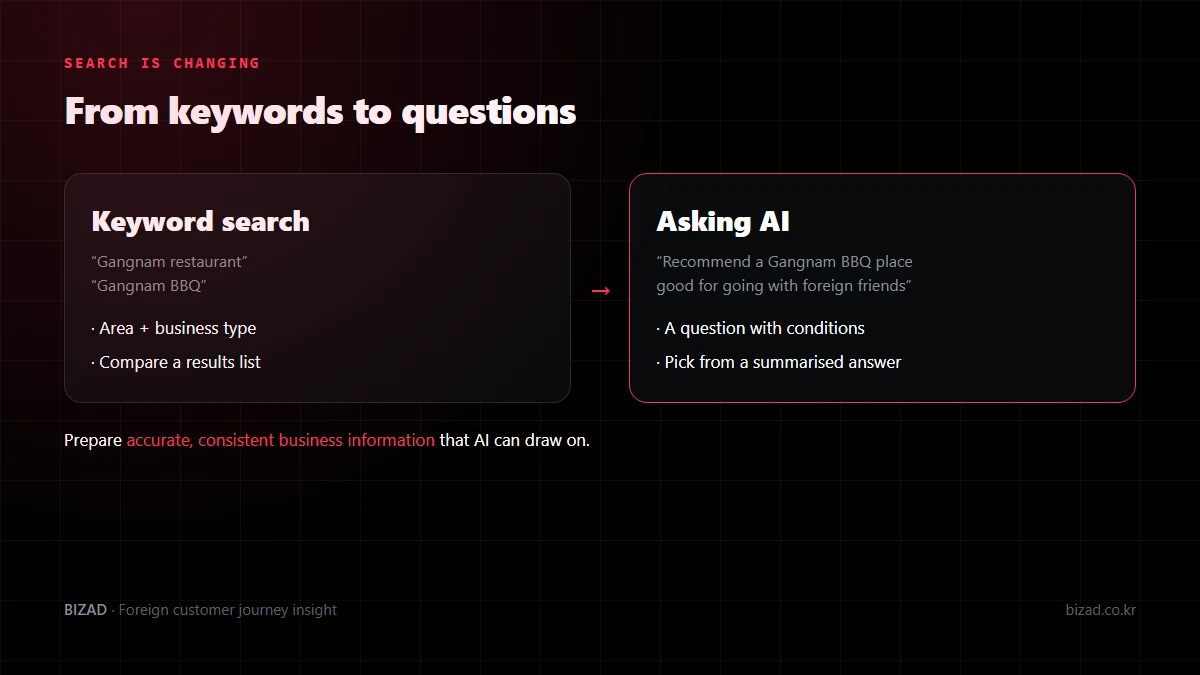
To answer such questions, AI needs information such as your location, type of business, menu or services, hours and reviews. How AI picks information differs by service and much of it is not public, but the more accurate and consistent your public information is, the easier it is to describe your business correctly.
So rather than doing something special for AI search, the starting point is making your information on Google Maps, your website and each platform accurate and consistent. A description that states clearly what you do, your menu and real customers’ reviews can also help.
What should we prepare first to welcome foreign customers?
Start by deciding who comes to your business, or who you want to come. Once that is clear, the platforms they use and the languages you need follow from it.
- 01Define your customers: check which countries they come from and which app brought them.
- 02Google Maps basics: align your business name, category, address, hours and photos with how things are now.
- 03Add platforms for your customers: for mainland Chinese customers, prepare Dianping, Amap and Xiaohongshu.
- 04Foreign-language information: put your menu, prices, booking method and payment options into your customers’ languages.
- 05Check consistency: confirm the name, address and hours are the same on every platform.
- 06Compare with real records: set platform figures beside your actual enquiries and bookings.
You do not need to do everything at once. We recommend finding where the customer journey breaks first right now and filling that gap first.
Foreign customer journey checklist
Start by checking your foreign customers’ journey against these points.
- We know which countries our foreign customers come from.
- We ask customers which app brought them to us.
- The basic information on our Google Business Profile is up to date.
- If we welcome mainland Chinese customers, we are on Dianping and Amap.
- The name used in our Xiaohongshu content can be found on map and review apps.
- Our name is spelled the same in foreign languages on every platform.
- Our address, hours and phone number are the same on every platform.
- We provide our menu, prices and booking method in our customers’ languages.
- We state only the languages we can actually handle.
- When information changes, we update every platform together.
- We look at platform figures together with real enquiries and bookings.
In closing
Foreign customers do not stay inside a single app. They discover you with the apps they use at home, check you through reviews and photos, and find their way to you on a map. If the journey breaks at any point, it rarely ends in a visit.
So before adding more platforms, decide who your customers are, and start by checking that your information looks accurate and consistent wherever those customers look.
We’ll first check how your business currently looks on the platforms foreign customers use.
Get a free review