At a glance
Xiaohongshu (RED) is where Chinese customers search for destinations, restaurants, clinics and shopping, compare reviews and photos, and save what they like. It is often called the Chinese Instagram, but for a business it is more accurate to treat it as a search platform.
How posts are ranked in search has not been officially disclosed, so no one can say for certain. What practice consistently shows is that posts with a clear topic, real answers to the searcher’s questions and information worth saving keep being used.
What is Xiaohongshu?
Xiaohongshu (小红书, also known as RED) is a Chinese-language content platform where users post reviews, photos and videos of their own experiences, and others search for and save them. Many Chinese customers look here first for restaurants, cafés, clinics, beauty and shopping when planning a trip to Korea.
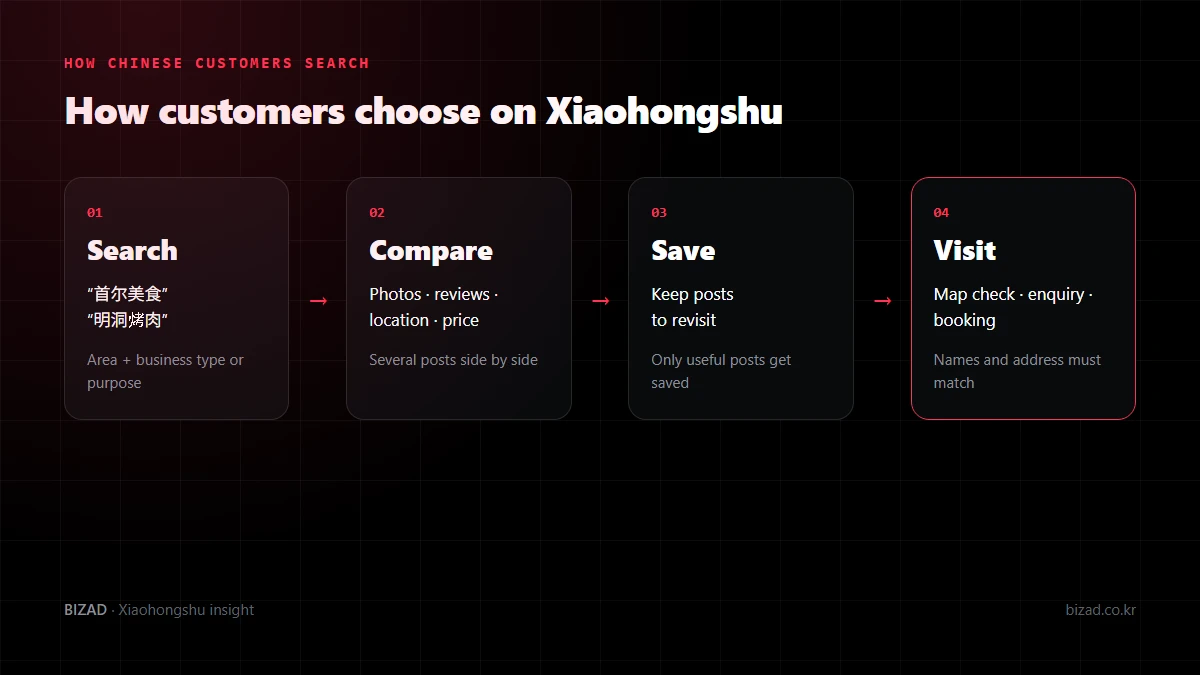
Chinese customers usually search by combining an area, a type of business and a purpose, like this:
- 首尔美食 (Seoul food), 明洞烤肉 (Myeongdong BBQ)
- 圣水洞咖啡店 (Seongsu-dong cafés), 弘大美发 (Hongdae hair salons)
- 江南皮肤科 (Gangnam dermatology), 韩国旅行攻略 (Korea travel guide)
They then compare photos, reviews, locations and prices across several posts, save the ones they like and open them again as the trip approaches. That is why, on Xiaohongshu, posts that help people decide to visit last longer than posts that simply look good.
How does Xiaohongshu decide what shows up in search?
Xiaohongshu has not officially published how search ranking works, so the exact criteria are unknown. In practice, relevance between the topic and the search term, content quality, user reactions such as saves and comments, and freshness are generally understood to work together.
This is analysis based on observation, and how much each factor counts may change with platform policy. So it is safer to stick to the basics below than to chase particular tricks.
- Keep each post to one topic.
- Make the area, business type and content clear in the title and first sentence.
- Make sure the body actually answers the title. If the title says “Myeongdong restaurant”, the menu, prices and location should be in the post.
- Use photos that back up what the text says.
The starting point is not stuffing in keywords but making it clear which question the post answers.
What should you prepare before opening a business account?
Start by putting your basic business details together in several languages. Chinese customers who find you on Xiaohongshu check again on maps and messaging channels, and they only recognize you as the same place if the details match everywhere.
- Business name in Korean, Chinese and English
- Street address, building name and floor, nearest subway station
- Opening hours, closed days and how to book
- Languages you can genuinely support, and when
- The name to search for in map apps
Rather than adding long strings of keywords, choose an account name that makes your official name and business type easy to recognize. In your posts, include the Korean business name and address in a form that is easy to copy into a map app.
If the account is created with an employee’s personal phone number, access can become difficult when that person leaves. Set it up with company contact details from the start, and decide who looks after the password and recovery options.
Do you need Xiaohongshu business verification?
Not every business needs it. But for businesses where consultations and bookings matter, such as clinics, beauty services and franchises, verification that shows an account is official can help build trust.
Xiaohongshu offers a separate professional account verification for sole traders and companies, with a review based on submitted documents. Which business types can be verified and which documents are needed can vary by country, industry and company type.
- For industries that need specific qualifications, such as medical, health, finance and education, check the criteria before applying.
- Korean businesses may fall under overseas-business requirements, so check the latest submission rules just before you apply.
- If the business name or representative on your documents differs from the account details, the review may take longer.
- After verification, keep your business details and licences up to date.
Verification does not by itself increase your reach. It is a starting point for trust; real results depend on the content you post afterwards and how accurate your information is.
How should you use hashtags and keywords?
Keywords go in the title, first sentence and body to describe what the post is about; hashtags go at the end to link it to related topics. Hashtags alone, without matching content in the post, do not help the person searching.
Choose one main keyword per post and make it specific by combining an area with a business type, a menu item or service, or a purpose.
| Pattern | Korean | Chinese |
|---|---|---|
| Area + business type | 성수동 카페 | 圣水洞咖啡店 |
| Area + menu | 명동 고깃집 | 明洞烤肉 |
| Area + service | 강남 피부과 | 江南皮肤科 |
| Area + purpose | 서울 사진 찍기 좋은 카페 | 首尔拍照咖啡店 |
Avoid popular tags that have nothing to do with the post, and avoid tagging Myeongdong or Gangnam when your store is actually in Hongdae. Think of hashtags and keywords as a promise to customers about who you are and where you are.
In what order should a Xiaohongshu post be written?
Follow the order of a real visit. Say what kind of place it is in the first sentence, and finish with the key details someone would want to save and look at again.
- 01Introduce, in one sentence, the situation the place suits.
- 02Give the location, nearest station and what makes it distinctive.
- 03Show the signature menu items or services with photos.
- 04Set out price range, opening hours and how to book.
- 05Note what is good and what to know before visiting.
- 06End with a short recap of name, address and hours.
Choose photos in the same order: exterior and entrance, interior, signature items or services, the menu and prices, and the way from the station — the things customers actually want to see.
Isn’t it enough to translate your Korean posts into Chinese?
Often it isn’t. The words Chinese customers search with differ from Korean expressions, and sentences that keep Korean word order can feel unlike the review-style posts people are used to on Xiaohongshu.
Korean buzzwords such as “hot place”, “café of my life” or “great value restaurant” may not match the search terms Chinese customers actually use, even when translated. The right order is to decide which words they will search with first, then write.
- Search terms: use area + business type + purpose instead of Korean slang.
- Sentences: write naturally, like a post by a real visitor, rather than like a notice.
- Emphasis: change it by industry — menu and prices for restaurants, space and seating for cafés, staff and time needed for beauty services.
Before posting, we recommend having a native speaker check that the Chinese reads naturally on Xiaohongshu.
Why shouldn’t a Xiaohongshu post look like an ad?
Because heavy ad copy makes it hard to find the information people need, and exaggeration makes them doubt your photos and reviews too. Xiaohongshu users are generally known to look for information they can judge for themselves rather than promotion.
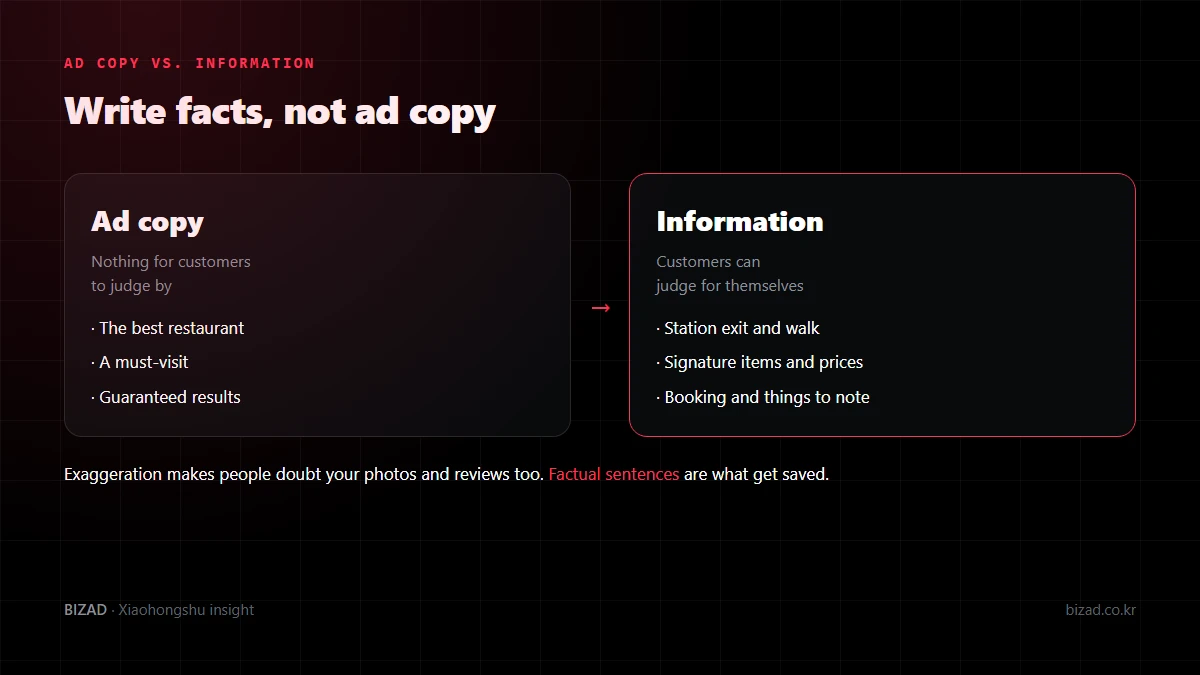
Replace lines like “the best restaurant”, “a must-visit” or “guaranteed results” with facts: location, menu, prices and how to book. Clinics and beauty businesses should be especially careful about promising results.
An official account can write from the customer’s point of view, but it should not dress its posts up as customer reviews. Making clear that the information comes from the official account earns trust that lasts.
What should you check when your Xiaohongshu views stay low?
First check that the post was actually published normally. Then work through the things you can change: keywords, titles, the amount of useful information and the focus of your account.
- Whether the post is still under review or has limited visibility
- Whether your keywords match what Chinese customers really search
- Whether the title and cover photo alone tell people what the post is about
- Whether it includes details worth saving, such as location, prices and hours
- Whether ad copy outweighs information
- Whether the account keeps changing topics or repeats near-identical posts
Reach can also vary with platform policy and account status, so check the community guidelines and any industry-specific rules as well. Rather than deciding on one cause straight away, change one thing at a time and compare the response.
Should you look at saves and comments rather than views?
Yes, look at them together. Views show how often a post was seen, but a save means someone plans to come back to it, and a comment can signal that they want to know more about location, prices or booking.
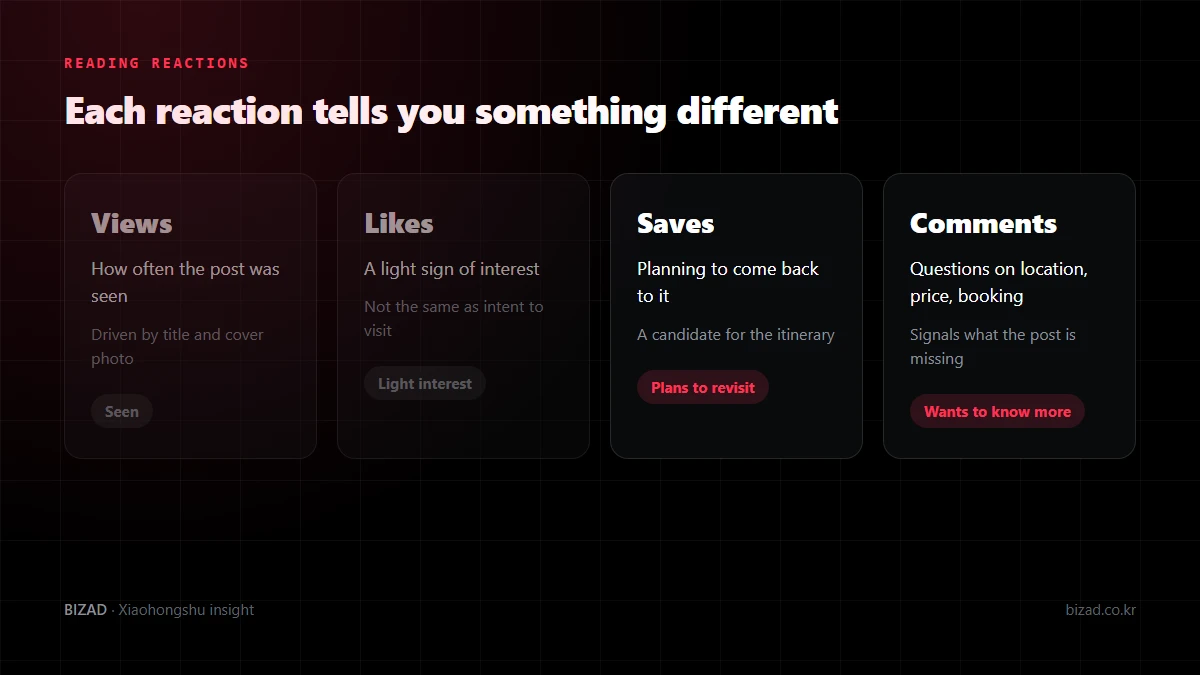
If the same question keeps appearing in the comments, that information is missing from the post. Lots of questions about location call for clearer directions; lots about booking call for a clearer booking explanation in your next post.
Answer comment questions specifically. But don’t assume that more saves or comments mean more visits — read them alongside your real enquiry and booking records.
Xiaohongshu checklist
Check these points before opening an account or publishing a post.
- I have our business name and address ready in Korean, Chinese and English.
- The account uses company contact details and has a named owner.
- I have checked whether our industry needs business verification.
- Each post has one main keyword.
- The title and first sentence make the area, business type and content clear.
- Hashtags only reflect our real location and content.
- A native speaker has checked that the Chinese doesn’t read like a translation.
- Posts give location, menu, prices and booking details instead of hype.
- Each post ends with a short recap worth saving.
- I use saves and comment questions to improve the next post.
In closing
Xiaohongshu isn’t a place where posting more automatically brings results. It is a process of learning how Chinese customers search and steadily building information that answers their questions.
Search ranking is not disclosed and policies can change, so the basics will serve you longer than tricks. Start by getting your business name, address and main keywords in order.
We’ll start by checking which words Chinese customers would use to find you, and how you appear on Xiaohongshu today.
Free audit