At a glance
Amap (Gaode Maps) is the map app many Chinese customers use at home, and they can use it in Korea too to check where a business is and how to get there. If Dianping answers “is it worth going?”, Amap answers “how do I get there?”.
So even with good reviews and photos, you can lose customers at the last moment if they cannot find you on the map. The basics are keeping your name, address, map pin, floor and opening hours identical to your other platforms.
Why do Chinese customers use Amap in Korea?
Because it is the map app they already use in China, so it feels familiar while travelling. Travellers usually prefer to find their way with an app they know rather than learn a new one.
On a trip to Korea people move between many places in a day, so how long it takes to reach you and which station to get off at affect which business they choose. These are the questions they try to answer on the map.
- Where exactly is the place?
- How long will it take from here?
- Which subway station and exit are closest?
- Which floor of the building is it on?
- Is it open now?
How much detail Amap shows for Korean locations can vary by area and over time. We recommend searching for your business yourself to see how it appears.
How is Amap different from Dianping?
They play different roles. Dianping is where customers compare and choose a place by reviews, ratings, photos and prices; Amap is where they check the location of the place they chose and get there.
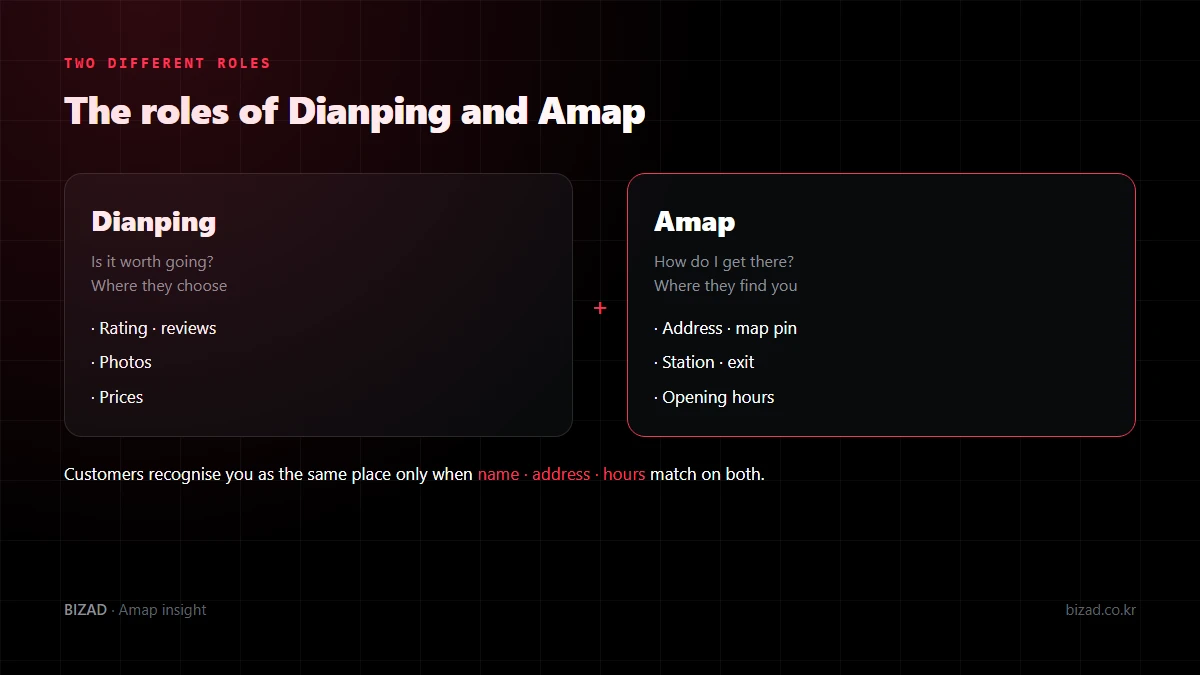
| Dianping | Amap | |
|---|---|---|
| Customer’s question | Is it worth going? | How do I get there? |
| Main information | Rating, reviews, photos, prices | Address, map pin, route, hours |
| If information is missing | You lose out at the comparison stage | They give up just before visiting |
Both apps show business information, but customers expect different things from each. Layouts and features change with updates, so check the current screens yourself.
Should we manage Amap and Dianping together?
Yes, we recommend it. Manage only Dianping and you may lose customers when they check the location; manage only Amap and you may lose them when they choose.
When managing both, the first thing to align is your basic information.
- Business name and Chinese name
- Address and map pin position
- Opening hours and closing days
- Phone number
- Main photos
If you are called A on Dianping but B on the map, or the two addresses differ, customers cannot tell which is right. When you change one, it is best to change the other on the same day.
How do Chinese customers split content, review and map apps?
They often check content, reviews and maps in different apps. They discover a place on a content platform such as Xiaohongshu, check it on Dianping, and find their way with a map app such as Amap.
There is more than one map app, too. Besides Amap, some customers use apps such as Baidu Maps, so which one they use varies from person to person.
So rather than worrying about visibility in one particular app, the realistic approach is to align your basic information so customers see the same name and the same location whichever app they search in.
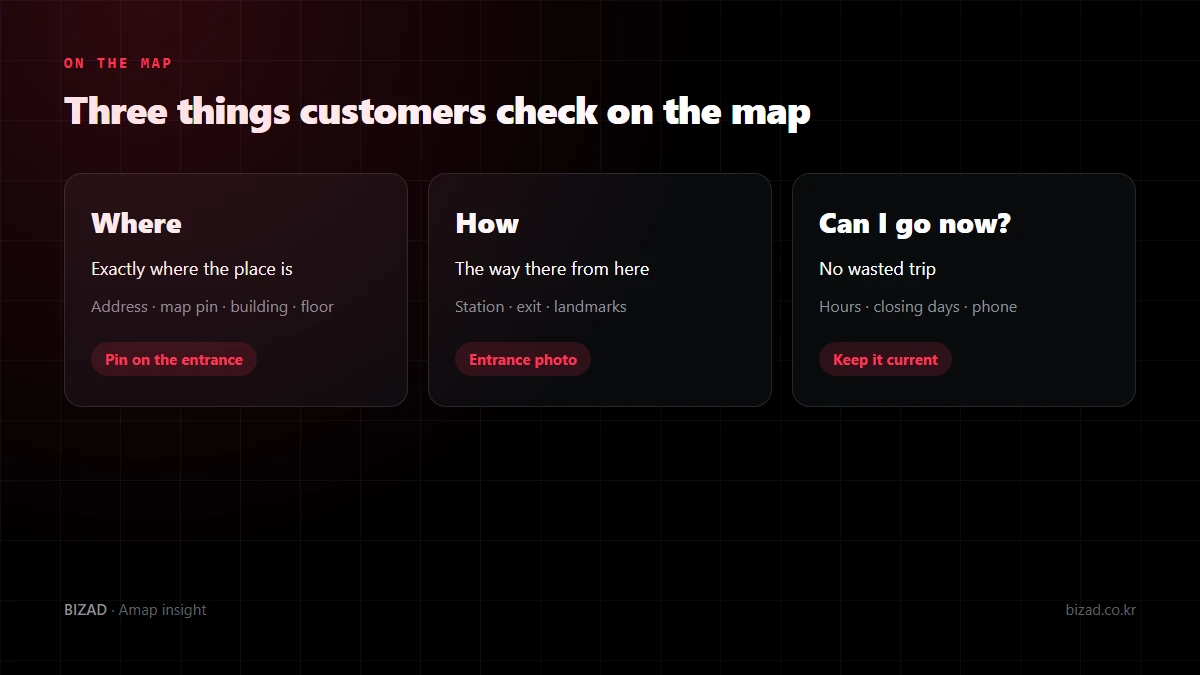
What do Chinese customers check on the map before visiting?
They check where you are, how to get there and whether they can go now. Korean road-name addresses and Korean-language signs can be unfamiliar to Chinese visitors, so a single line of address is often not enough.
| What they check | Information needed |
|---|---|
| Where is it? | Exact address, map pin, building name, floor |
| How do I get there? | Nearest subway station, exit number, walking time, nearby landmarks |
| Will I recognise it? | Exterior photo, entrance photo, Chinese name |
| Can I go now? | Opening hours, closing days, break time, phone number |
If only a Korean name is listed, customers struggle to read or search for it. A Chinese name and an exterior photo let them recognise you even if they cannot read the sign.
What else should a business inside a building prepare?
Explain how to find you inside the building, such as the floor, entrance and lift location. Businesses inside buildings, such as clinics, dermatology clinics and beauty salons, are hard to reach from an address alone.
- Clinics and dermatology: building name, floor, lift location, entrance photo
- Restaurants and cafés: alley entrance, exterior photo showing the sign, nearby landmarks
- Shops in malls or department stores: floor and zone, nearest entrance
- Accommodation: how to get there from the airport and subway station, where to check in
A moment customers find especially frustrating is arriving nearby and not finding the entrance. A single entrance photo can help prevent that.
Is it fine if the map pin is slightly off?
Where possible, move it to your actual entrance. Customers walk towards the pin, so if it sits behind the building or on the building next door, they end up wandering around nearby.
Even with the right address, the pin can be in the wrong place, so open the map app in front of your business and check that the pin matches the entrance. If you have moved, also check that the old address or old pin is not still showing.
How to correct a pin and how long changes take to appear can differ by platform. After correcting it, check again that the change has actually gone through.
What does it take for a saved place to become an actual visit?
When customers come back to a place they saved, they need to find the same business easily and see its location and hours straight away. Saving is only a sign of interest; the visit is often decided when they pull it up again during the trip.
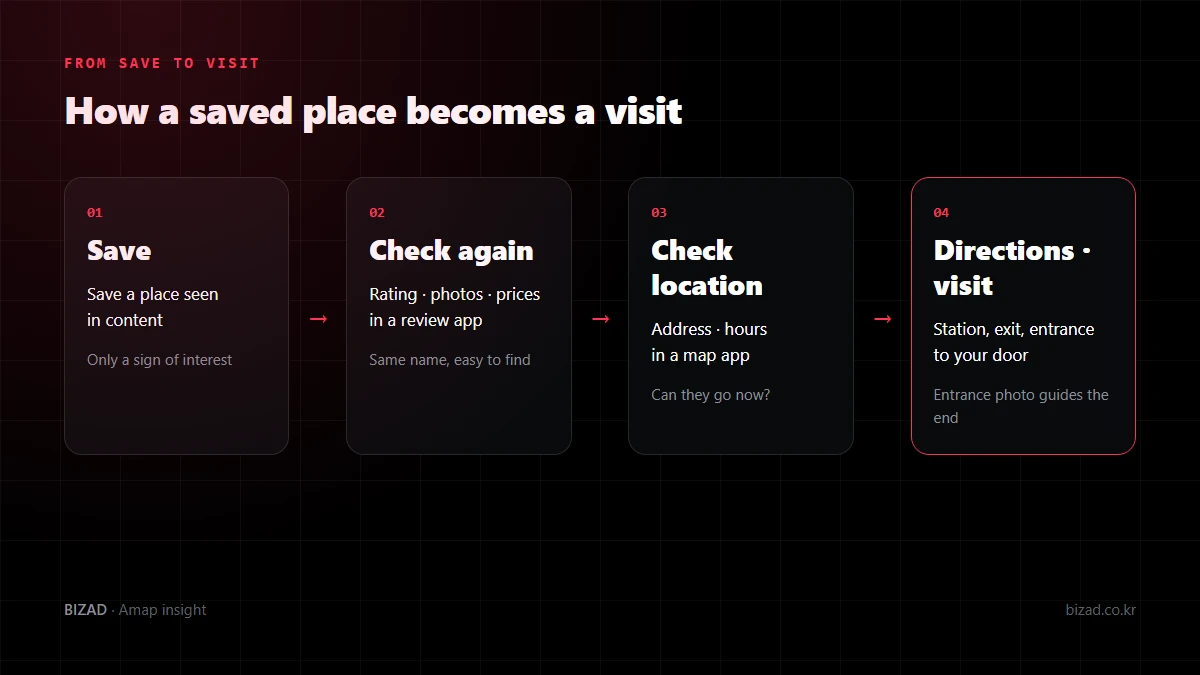
If the information breaks at any point in this flow, customers do not move on to the next step. If the name used in content cannot be found on the map, or wrong hours mean they arrive to a closed door, the save never becomes a visit.
When creating content such as Xiaohongshu posts, include the Chinese name that customers can search on the map and accurate location details, so people who save it can find their way later.
Once our Amap information is listed, are we done?
No. Opening hours, closing days, phone numbers and photos change as you operate, so they need regular checking. Outdated map information leads to wasted trips, and that experience can show up in reviews on other platforms.
- When hours or closing days change, update the map app, Dianping and Google Maps on the same day.
- Add holiday or temporary closures in advance.
- Upload new photos when the exterior or entrance changes.
- Search for your business name regularly to see how it appears.
Managing map information is not eye-catching work, but it is responsible for the final step that brings customers to your door.
Amap checklist
Start with these points to check whether Chinese customers can find their way to you.
- We have searched our business name on Amap ourselves.
- Our Chinese name is the same as on Dianping and Xiaohongshu.
- The address is current and no old address remains.
- The map pin matches our actual entrance.
- We give the building name, floor and entrance directions.
- We show the nearest subway station and exit.
- Exterior and entrance photos show how we look now.
- Opening hours, closing days and break time are up to date.
- Our phone number works and is the same on every platform.
- The name used in our content can be found on the map.
- When information changes, we update every platform on the same day.
In closing
Amap handles the step where customers, having chosen you, actually make their way to you. Even if reviews and content have won their interest, that interest will not become a visit if they cannot find you on the map or the information is wrong.
Start by checking that the name and location details on Dianping, Amap and Xiaohongshu match. Simply aligning the basics reduces the places where customers get lost.
We’ll first check how your business looks on the map and review apps Chinese customers use.
Get a free review