At a glance
Chinese travellers find and save places on Xiaohongshu before they arrive in Korea, then open that list again during the trip. Some information is checked in every industry, such as location, prices and booking, and each industry also has details people look at more closely.
For restaurants it is the menu and waiting time; for beauty, result photos and staff; for clinics, the consultation process and how costs are explained; for hotels, location and cleanliness; for shops, payment and tax refunds. Start by listing what your customers ask, and what to prepare becomes clear.
When do Chinese travellers look up Korean businesses?
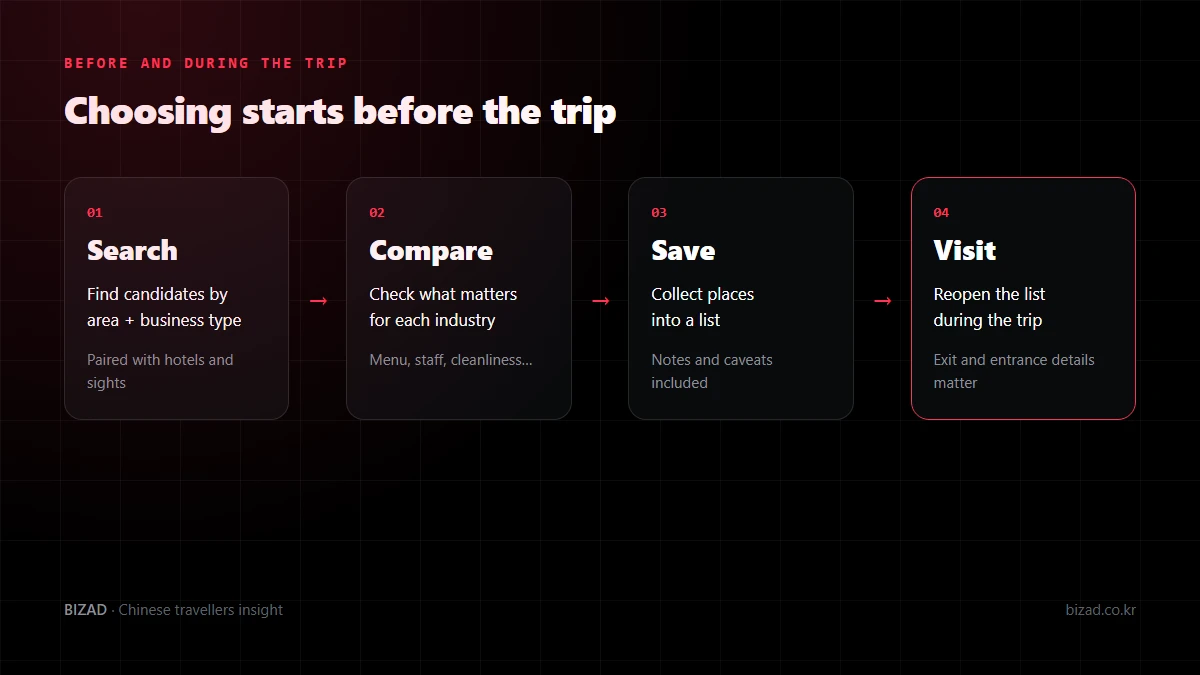
Often before they arrive, while planning the trip. They search Xiaohongshu by area and business type, save the places they want to visit, and open the list again during the trip to pick what fits their schedule.
They also tend to search for a business together with their hotel, sights or shopping areas rather than on its own.
- Restaurants near a Myeongdong hotel
- A hanok café to visit after Gyeongbokgung Palace
- A dermatology clinic to drop by after shopping in Gangnam
- Late-night restaurants near a Hongdae hotel
So when you describe your business, include the nearest station, nearby sights and places worth combining with yours. That makes it easy to fit you into an itinerary.
Is there information they check whatever the industry?
Yes. In almost every industry they check the exact location and how to get there, prices, opening hours, how to book, language support and payment options.
- Business name in Korean, Chinese and English, plus an address they can copy
- Nearest subway station and exit, walking route, and which floor
- Price range and when extra costs apply
- Opening hours, closed days and whether booking is needed
- Whether foreign languages are supported, and which payment methods work
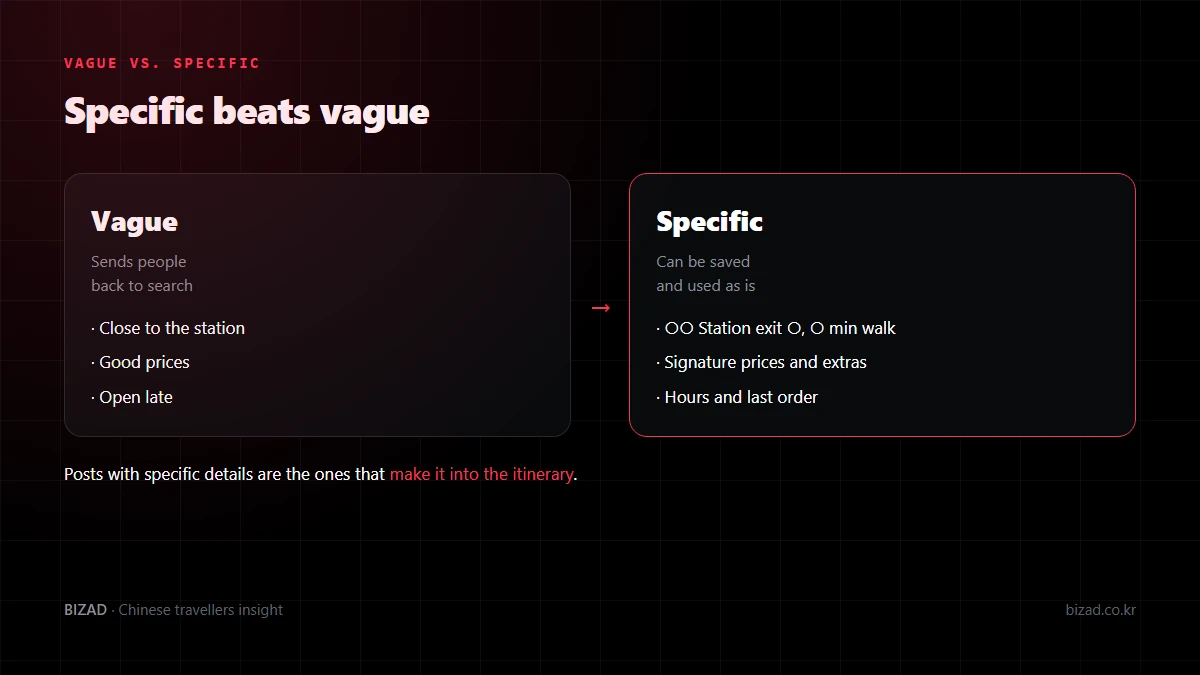
Specific directions — exit number, walking time, what the building looks like — get saved and used, while vague lines like “close to the station” do not.
How do Chinese travellers choose restaurants and cafés?
They first look at what the food really looks like, how much it costs and how long the wait is. Pretty photos alone aren’t enough; a place makes the shortlist when it is also clear that foreigners can order easily.
| What they check | Restaurants | Cafés |
|---|---|---|
| Key details | Signature dishes, real portions, price per person | Signature drinks and desserts, prices |
| Timing | Waiting time, break time, last order | Busy weekend hours, items that sell out |
| On site | Foreign-language menu, how to order | Seating, photo spots, how comfortable it is to stay |
| Route | Nearby sights, distance from hotels | Streets or sights worth combining |
For cafés, photos of the space catch the eye first, but the decision to visit comes when menu, prices and busy times are there too. For restaurants, explaining how to order the signature dish takes pressure off foreign guests.
What do people look at before booking a beauty salon, hair salon or nail shop?
Result photos and the staff member come first. For services where results vary by person, such as cuts, colour and nail designs, people often book based on who does the work rather than the shop itself.
- The stylist’s speciality and portfolio
- Base price and when extra costs apply (length, bleaching, extra design, etc.)
- Time needed — whether it fits between other plans
- How to book, and the change and cancellation policy
- Whether they can consult using photos of the desired style
Showing how you actually consult — “we check your hair condition, then suggest colours that are possible” — earns more trust than “the best designer”. Use real result photos without heavy retouching.
What do they check for clinics such as dermatology or plastic surgery?
They check official information, the medical staff, the consultation process and how costs are determined. Because it is a decision about their body, they tend to compare reviews and official channels for longer than in other industries.
- Whether the account is official, and whether clinic and doctor information is clear
- When and how consultations in Chinese are available
- The process from consultation to treatment and aftercare guidance
- What the listed price includes, and whether extra costs may apply
- How to get in touch after treatment
If the same treatment has different names on different channels, people get confused, so keep the names on Xiaohongshu, booking channels and your website consistent. Avoid stating results as certain, and check the medical advertising laws that apply before creating content.
What do they look at before booking a hotel?
They pay more attention to real guests’ experiences than to official room photos. Reviews tell them about bedding and bathrooms, noise, check-in and staff — the things you notice when you stay a night or more.
- Nearest station and exit, airport bus stop, and whether it is easy to find when arriving late
- Clean bedding and bathrooms, soundproofing, heating and cooling, Wi-Fi
- Check-in process, luggage storage, language support
- Nearby convenience stores and restaurants, distance to shopping streets
No hotel avoids negative reviews entirely. Rather than arguing, a reply that acknowledges the problem, explains what will improve and offers an alternative available now shows future guests how well the place is run.
What do they check in advance about shops?
They check which products they can buy where, and whether payment and tax refunds will work. Many Chinese travellers make a shopping list before the trip.
- Brands sold, signature products and price range
- Accepted payment methods, such as cards and mobile payments
- Whether tax refunds are available, and the conditions
- How to ask about stock, gift wrapping, exchange and refund policy
Stating conditions precisely — “tax refund eligibility may depend on the purchase amount and product” — works better than “lots of discounts”. Payment options can change, so only list the ones you actually accept.
What do Chinese travellers save before their trip?
They save the information they will need to actually go, more than the place itself. Posts that bring together location, prices, hours, directions and things to know before visiting are the ones that get saved.
- Routes by area — which order to see things in
- Restaurants and facilities near the hotel that stay open late
- Transport and directions — exit number, building exterior, entrance photo
- Things to note — waits, items selling out, advance booking, limited payment options
Posts that include honest notes are more useful for planning than posts with only positives. Saved posts are reopened just before a visit, so update hours and prices as soon as they change.
Which photos should each industry prepare?
Prepare the scenes customers wonder about before visiting, industry by industry. Official photos show the mood, while photos close to reality let people judge what it would be like for them.
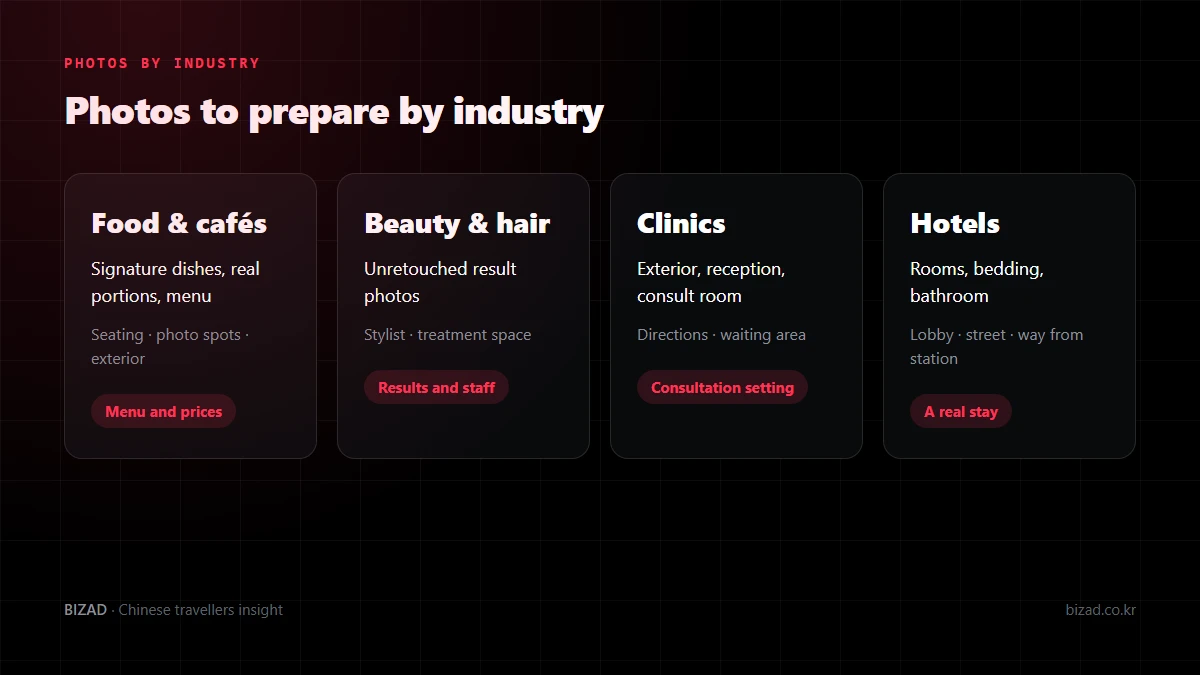
In every industry, photos of the exterior, the entrance and the way from the station help. Also check that any menu or price list in your photos matches what you charge today.
Should you say Chinese-language consultation is available?
Only if someone can genuinely help. Chinese-language support is something people check closely in booking-based businesses such as beauty, clinics and hotels, so a gap between what you say and what happens on site quickly costs trust.
- Days and hours when consultation is available
- How it works — messaging, phone, photo consultation, etc.
- Whether advance booking is needed
- If you can’t reply right away, roughly when you will
If nobody can help in Chinese, state precisely what you do offer, such as “Chinese menu available” or “ordering via a translation app is fine”. Even small notes ease customers’ worries when they are accurate.
Welcoming Chinese travellers: checklist
Start with the points below, adapted to your industry.
- Our description lists the nearest station, nearby sights and places worth combining.
- We include our name in Korean, Chinese and English and an address people can copy.
- Directions are specific: exit number, walking time, floor.
- We state our price range and when extra costs apply.
- Opening hours, closed days and booking requirements are up to date.
- We have listed separately what customers in our industry check most closely.
- Information with conditions, such as payment and tax refunds, includes those conditions.
- We mention things to note, such as waits, items selling out and advance booking.
- We have real photos suited to our industry.
- We only advertise Chinese-language support for the scope and hours we can actually offer.
In closing
Chinese travellers have already made a list of places before they reach Korea. To get onto that list, show the information customers in your industry check, specifically and accurately.
Start by writing down what your customers ask before they visit. The answers to those questions are exactly what to post on Xiaohongshu.
We’ll start by checking what Chinese customers in your industry look for, and what is missing from your business information today.
Free audit