At a glance
When choosing a clinic in Korea, foreign patients check Google Search, Google Maps, social media and platforms from their own country together. Among these, Google Maps is where they confirm location, opening hours, photos and reviews on a single screen.
Patients choose a clinic far more carefully than a shop, so accurate information and a sincere tone matter. Clinics must also follow Korea’s medical advertising rules, so it is worth double-checking before handling reviews or writing a description.
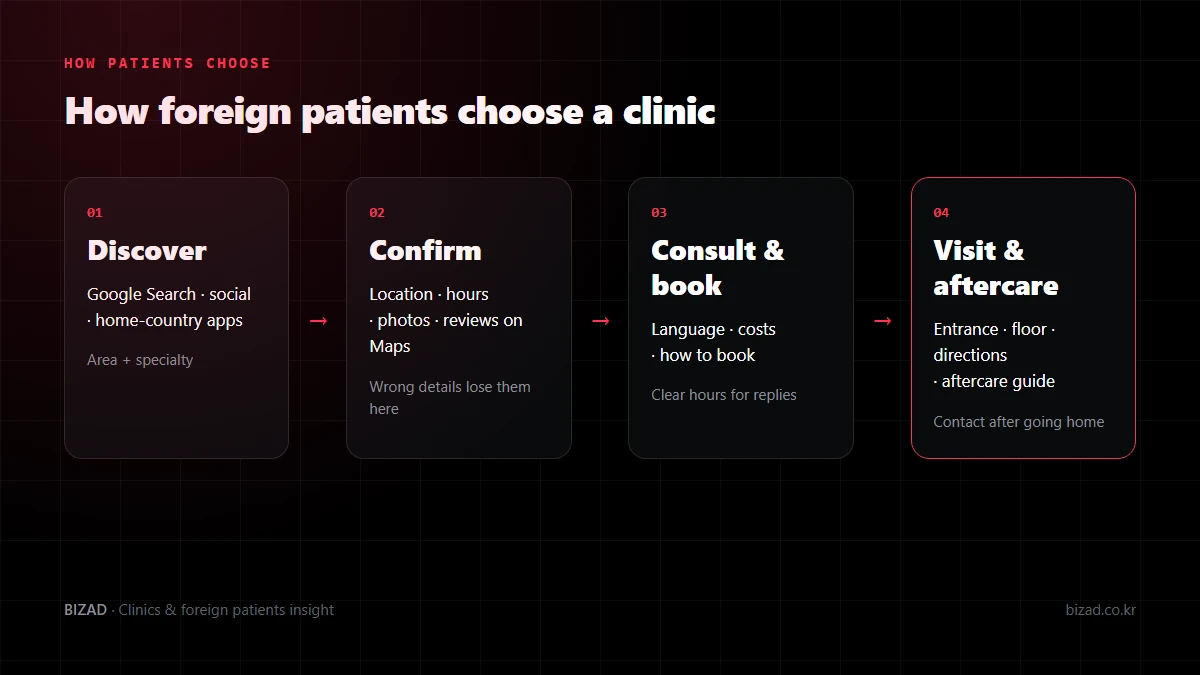
Where do foreign patients look for a clinic in Korea?
Many start with Google Search and Google Maps. While Korean patients rely mainly on Naver Place and blogs, foreign patients usually check the Google they already use alongside social media and platforms from their home country.
Their searches often combine an area, a medical specialty and a language.
- dermatology clinic Gangnam, acne clinic Seoul
- English speaking clinic Seoul, dental clinic near me
- 首尔 皮肤科, 江南 牙科 (Chinese)
- ソウル 皮膚科, 江南 歯科 (Japanese)
An English website on its own is not enough to appear for these searches. Google needs to be able to connect your clinic’s name, specialties, location, hours, photos and reviews as one picture.
Does a clinic with mostly Korean patients still need Google Maps?
Yes, it is best to manage it alongside Naver. Naver matters for Korean patients’ searches, while Google Maps is the channel for foreign patients, patients who mainly use Google, and AI search.
If you only manage Naver and leave your Google profile untouched, patients who find you on Google may see outdated hours or empty fields. Trust matters especially for clinics, so one wrong listing can make the whole clinic look neglected.
Google says that complete and accurate business information helps it match your business with relevant searches. As more people ask AI search full questions, the hours, location, photos and reviews on your profile become the material that describes your clinic.
What do foreign patients check on Google Maps?
First they check where the clinic is, whether it is open now, and whether they can consult in their language. Because they have to find a clinic in an unfamiliar city, they pay close attention to map details.
- An English clinic name and easy-to-understand descriptions of specialties
- Building name, floor, nearest subway station and exit
- Opening hours, lunch break, closed days, weekend or evening hours
- Languages available for consultation, and when
- How to book, phone number, website and booking link
- Whether parking is available
Of these, opening hours are especially often wrong. If Google Maps shows “Open” but it is actually lunch break or a closed day, a patient who came in feeling unwell will feel more than inconvenienced — they will lose trust. We recommend adding public holidays and temporary closures in advance.
What photos should a clinic post on Google Maps?
Post photos that help first-time patients find their way and see the inside in advance. Even without understanding Korean descriptions, patients can grasp the clinic’s atmosphere and layout from photos.
- Building exterior, entrance and where the elevator is
- Reception and waiting area
- Consultation and treatment rooms
- Foreign-language signs
- Parking entrance
Exterior and entrance photos help patients recognise the clinic when they arrive at the building. Images that show treatment results, such as before-and-after comparisons, may fall under medical advertising rules, so we recommend checking those rules before posting.
How should a clinic manage its Google reviews?
Focus on replying sincerely to what patients say rather than on collecting as many reviews as possible. Future patients read clinic reviews to judge how the clinic treats people.
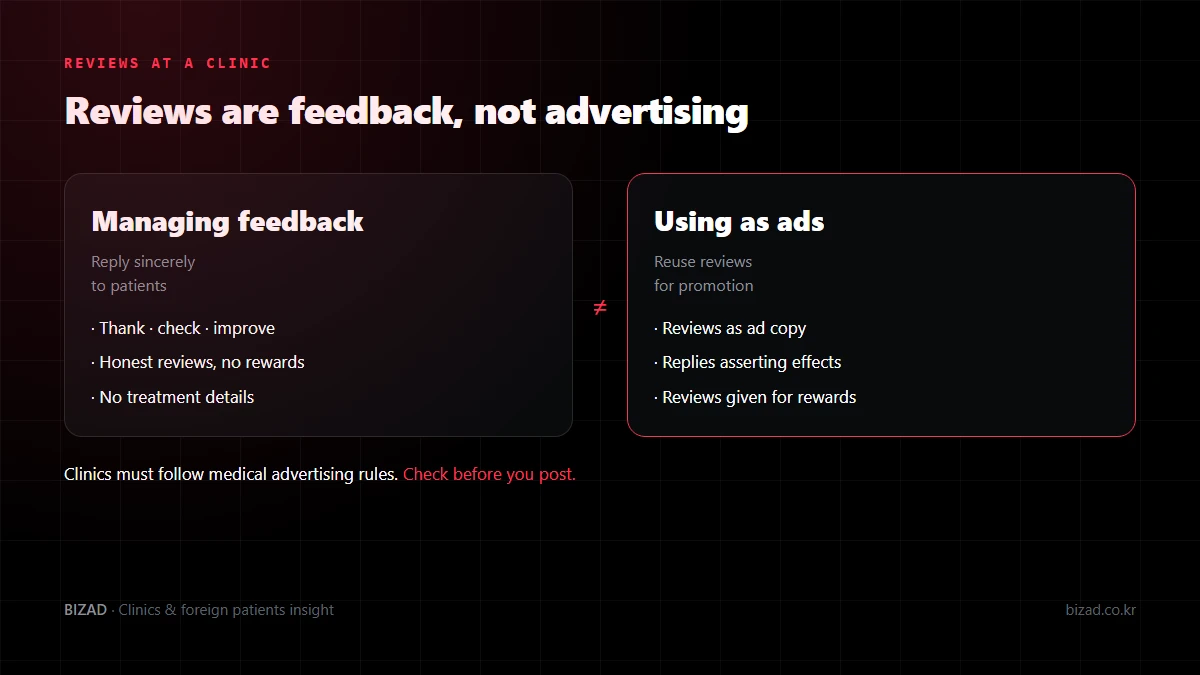
When asking for reviews, it is appropriate simply to invite patients who actually visited to share their honest experience. Giving anything in return for reviews is not allowed under Google’s policies, and it is best not to ask for a particular rating or wording.
Unlike ordinary shops, clinics must also follow medical advertising rules. Picking reviews from Google Maps and reusing them as promotional material or ad copy can cause problems, so we recommend treating reviews as patient feedback rather than advertising material.
How should a clinic reply to reviews?
Keep replies short and polite, expressing thanks, acknowledgement and a willingness to improve. It is safest to avoid wording that asserts treatment effects, promises results or compares your clinic with others.
Replies along these lines work well.
- Positive review: “Thank you for your kind words. We will keep guiding you carefully so that every visit feels comfortable.”
- Critical review: “We are sorry you had an uncomfortable experience. We will look into the waiting time and guidance you mentioned and improve them.”
- Review in English: “Thank you for your kind review. We will keep doing our best to make your visit comfortable.”
If you argue emotionally with a negative review, people remember your reply longer than the review. Leave treatment details and personal information out of replies, and if something needs checking, invite the patient to contact the clinic directly.
What should a clinic check before posting a description or social media content?
Check first that it complies with medical advertising rules. Google Maps descriptions, posts and social media content can all be read as advertising, so clinics need to be more careful with wording than ordinary shops.
We especially recommend double-checking the following before publishing.
- Wording that asserts treatment effects or promises results
- Wording that compares your clinic with others or claims superiority
- Using patient reviews or testimonials for promotion
- Photos that show treatment results
If you treat foreign patients, please check the relevant rules, such as whether your clinic is registered to attract foreign patients. Detailed standards can change, so when in doubt it is safest to confirm with the relevant authorities or a professional.
What do Chinese-speaking patients look at when choosing a clinic?
They usually decide by looking at the specialty, the doctors, the consultation process, how costs are explained and the location together. The more a treatment requires booking or a significant cost, the earlier they compare clinics — often before the trip.
| What they check | What the clinic should prepare |
|---|---|
| Specialty | Specialties and concerns you can consult on, in plain language |
| Doctors | Each doctor’s area of practice and working days |
| Consultation process | The steps from reception to consultation and treatment |
| Costs | What is included and when extra costs may apply |
| Language | When Chinese consultation is available, and through which channel |
| Aftercare | Post-treatment instructions and how to ask questions after returning home |
Treatment differs from person to person, so it is good to note that the actual treatment is decided after consulting a doctor. We also recommend deciding how to present costs after checking the medical advertising rules.
Why can’t patients find a clinic on Google Maps after seeing it on Xiaohongshu?
Usually because the clinic’s name is written differently on each platform. If it was introduced on Xiaohongshu under a Chinese name but Google Maps only shows the Korean name, patients cannot be sure it is the same clinic.
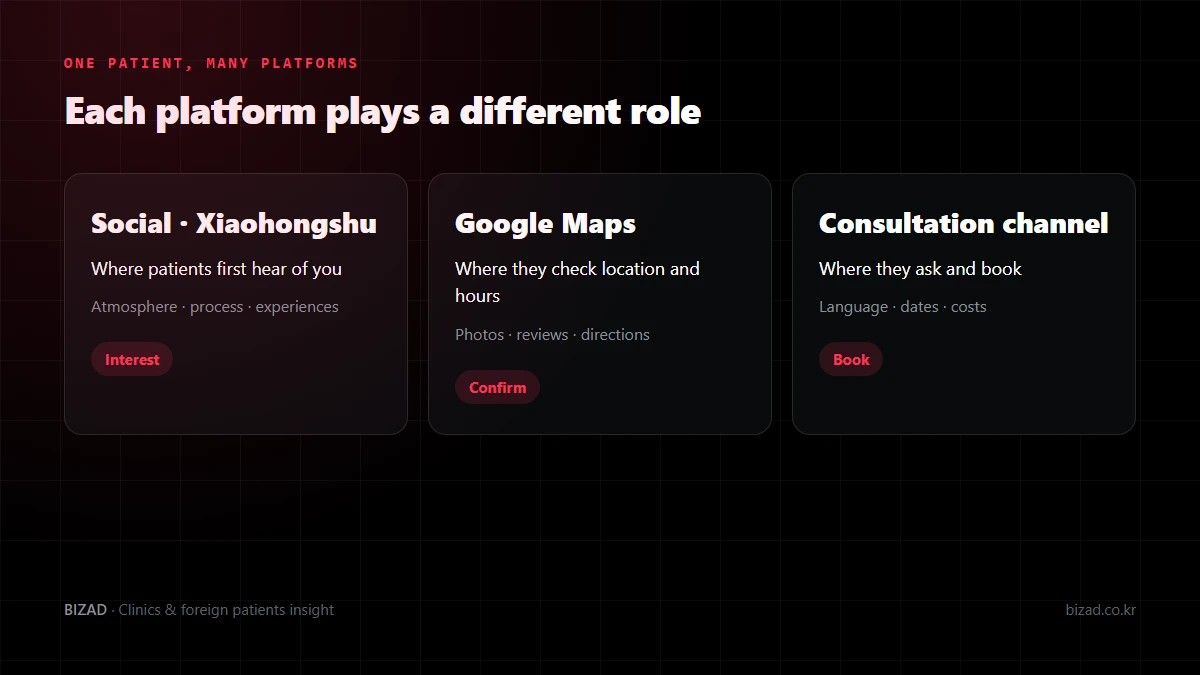
Keep the Korean, English and Chinese clinic names, address and hours consistent across platforms. Leave the business name on your Google profile exactly as it appears on your sign, and introduce the foreign-language names in your description, website and social media.
Social media is where interest begins; Google Maps is where patients confirm that interest and find the way. Only when the two connect smoothly does interest turn into consultations and visits.
How should a clinic prepare foreign-language consultations and aftercare?
Show clearly which languages are available and when, and provide post-treatment guidance in a form patients can read again later. Foreign patients often visit and leave the country within a short schedule.
- If foreign-language staff are not always on site, state the days and hours when consultation is available.
- If you use machine translation, have a staff member double-check important medical guidance.
- When booking, confirm the patient’s name, purpose of visit, preferred dates and consultation language in advance.
- Give post-treatment instructions as a written guide or message in the patient’s language.
- Let patients know how to reach you after they leave Korea.
Trust lasts only if you can actually respond in the languages you advertise. If you open a consultation channel, assign someone to it so replies are not delayed.
Foreign patient readiness checklist for clinics
Start by checking your clinic against these items.
- We have confirmed verification and management access for our Business Profile.
- Our clinic name, address and phone number match on Naver, Google and our website.
- Opening hours, lunch break and closed days are up to date.
- We have an English clinic name and easy-to-understand descriptions of our specialties.
- We explain the building entrance, floor and subway exit.
- Photos of the exterior, entrance, reception and waiting area show how they look today.
- We invite reviews without giving anything in return, and reply to them sincerely.
- Our replies and description contain no wording that asserts effects or promises results.
- We do not use patient reviews like advertising, and we check medical advertising rules before posting.
- Our Korean, English and Chinese clinic names match across platforms.
- We show which consultation languages are available, and when.
- We have post-treatment instructions and a way for patients to contact us after returning home.
In closing
Attracting foreign patients doesn’t happen with a single ad. It means making sure your clinic appears accurately where patients search, that they can understand it in advance through reviews and photos, and that consultation and booking flow without obstacles.
Trust matters especially for clinics, so accurate information lasts longer than exaggeration. Start by checking how your clinic looks to foreign patients on Google today.
We’ll start by checking how your clinic looks on Google Maps today — through the eyes of a foreign patient.
Free audit