At a glance
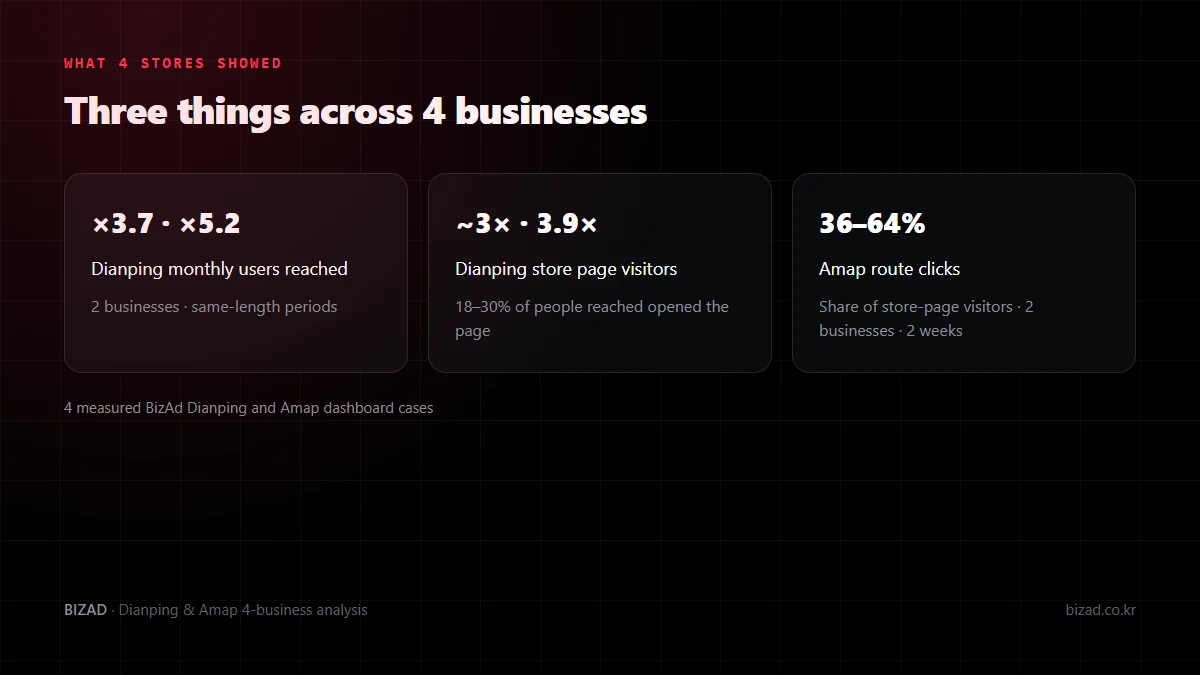
We re-examined dashboard figures from four businesses BizAd manages. For the two on Dianping (a Korean BBQ restaurant in Myeongdong and a dessert café in Jeju), comparing periods of the same length, monthly users reached grew 3.7× and 5.2×, and store page visitors grew about 3× and 3.9×.
The two apps play different roles. On Dianping, 18–30% of people reached opened the store page; on Amap, 36–64% of store-page visitors tapped the route button. Customers choose on Dianping and find their way on Amap.
Does managing Dianping actually increase visibility?
Yes, for both businesses. The Myeongdong BBQ restaurant went from 15,290 to 56,235 monthly users reached compared with the same period two years earlier — 3.7×. The Jeju dessert café went from 8,014 in its first month to 41,293 six months later — 5.2×.
| Business | Periods compared | Monthly users reached | Store page visitors | Users who took action |
|---|---|---|---|---|
| Myeongdong Korean BBQ | 2024.4.19–5.18 → 2026.4.19–5.18 | 15,290 → 56,235 | 3,314 → 10,110 | 1,451 → 5,223 |
| Jeju dessert café | 2025.11.17–12.16 → 2026.4.17–5.16 | 8,014 → 41,293 | 2,361 → 9,274 | 1,311 → 5,199 |
Both ran a store page (CPT), search and recommendation ads (CPC) and vouchers together, so the growth can’t be credited to any single action.
When impressions grow, does the visit rate hold?
It dipped slightly. The share of people reached who opened the store page fell from 21.7% to 18.0% for the Myeongdong BBQ restaurant and from 29.5% to 22.5% for the Jeju dessert café.
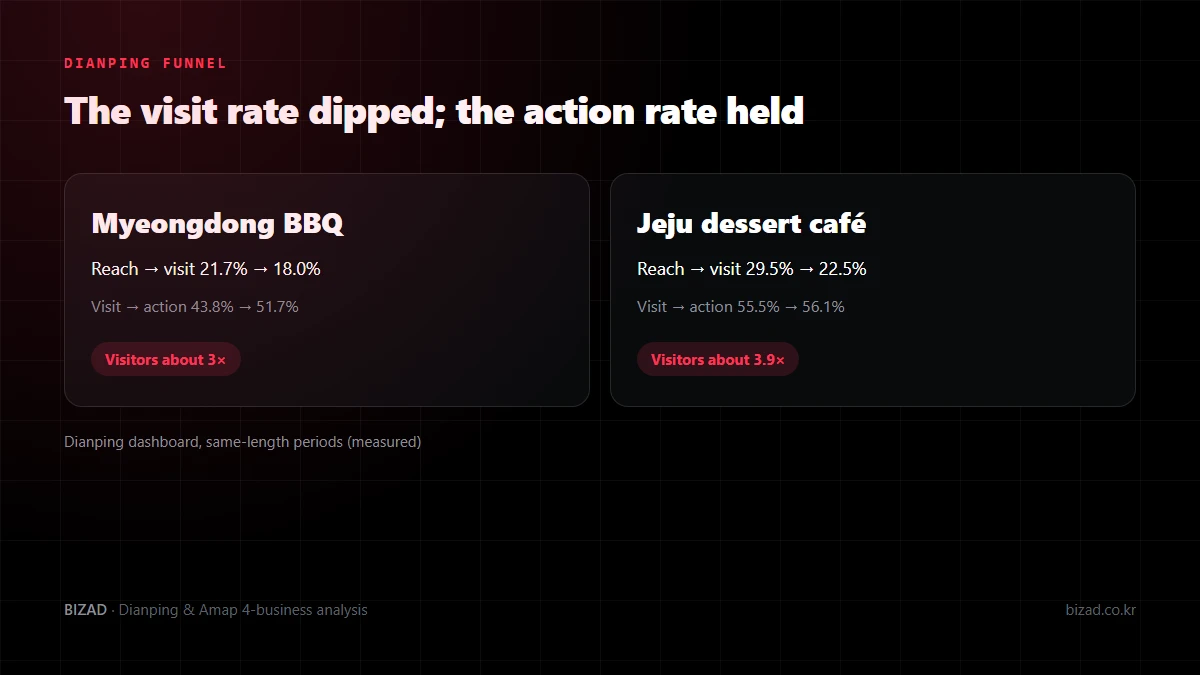
That isn’t a bad sign. Wider reach means the listing is shown not only to people looking for you but also to people browsing nearby. The rate went down, yet the number of visitors more than tripled — which is why visitors should be tracked alongside impressions.
What do customers do once they open the store page?
About half go on to take action. “Users who took action” is a metric Dianping counts: people who responded on the store page. As a share of store page visitors, it rose from 43.8% to 51.7% for the Myeongdong BBQ restaurant and held steady at 55.5% to 56.1% for the Jeju dessert café.
Even as reach widened, the share of visitors who stayed engaged didn’t drop. A store page with photos, menu, prices and reviews appears to be what holds them.
How did Amap look different from Dianping?
On Amap, the action that stood out was going there. In the two weeks after the store pages were improved, 35.7% of store-page visitors for the Gangnam BBQ restaurant and 64.1% for the Jeju attraction tapped the route button.
| Business | Impressions (2 weeks) | Store page visits | Route clicks | Route clicks vs previous 2 weeks |
|---|---|---|---|---|
| Gangnam Korean BBQ | 2,426 | 171 | 61 | +84.85% |
| Jeju attraction | 11,642 | 936 | 600 | +135.29% |
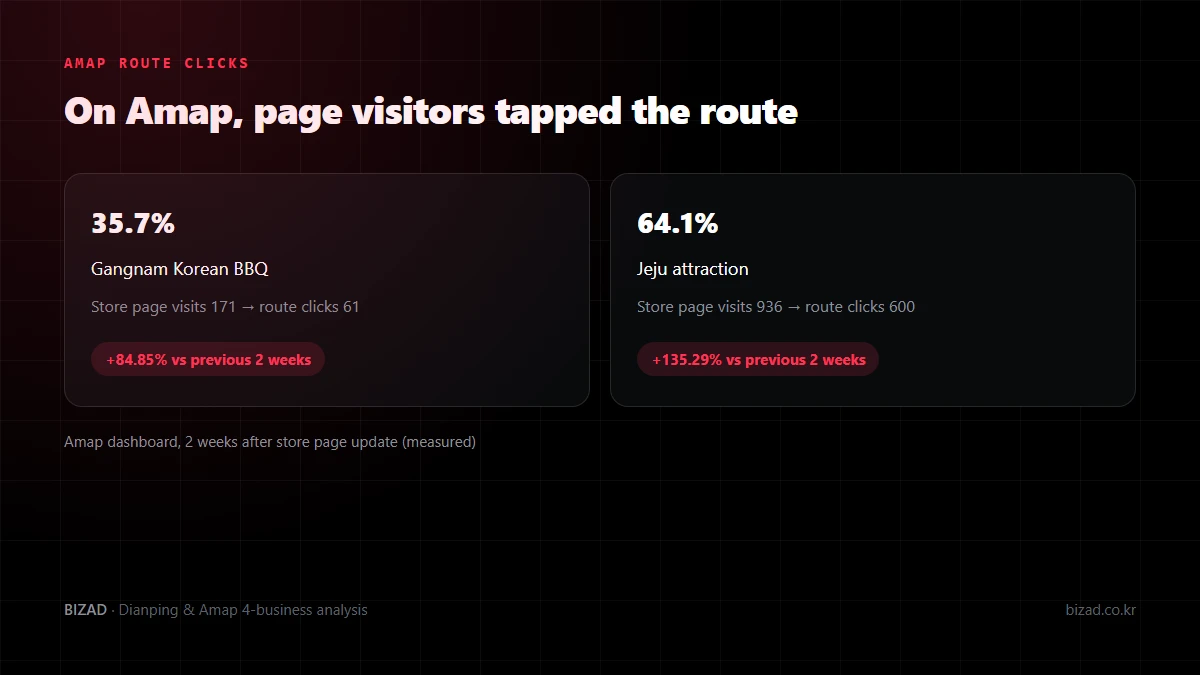
Store page visits as a share of impressions, on the other hand, were 7–8% — lower than on Dianping (18–30%). Amap is less an app for choosing a place than one for finding the way to a place customers have already chosen.
So should we run both apps?
If you serve Chinese customers, we recommend managing both. As the data shows, customers pick a place on Dianping and look up the route on Amap. With only one in place, they either choose you and can’t find you, or can find you but have no reason to choose you.
If the business name, address or map pin differs between the two apps, customers may not recognize them as the same place. Matching the Chinese name and location in both comes first.
How far can the Dianping and Amap data from 4 businesses be trusted?
These are four cases, so the results won’t apply to every business. The numbers are measured values copied as shown on each platform’s dashboard. But the businesses differ in category and district, the comparison periods differ (two years, six months, two weeks), and seasonal and travel-demand changes are mixed in.
Please read this not as a promise of how much things will grow, but as a reference for how impressions, visits and actions connect.
Chinese map app check for your business
Start with these on your phone.
- I searched for my business in Chinese on Dianping and Amap myself.
- The Chinese name, address and map pin match in both apps.
- The Dianping store page has recent photos, the menu and prices.
- I check store page visitors and actions every month, not just impressions.
- I check route clicks on Amap.
In closing
Two things were common across the four businesses: when impressions grew, the visit rate dipped slightly but the number of visitors rose sharply; and customers chose on Dianping, then found their way on Amap.
Start by checking that your business appears with the same name and location in both apps.
We’ll first check how your business appears on Dianping and Amap.
Get a free review